We have a novel paper, accepted for ICCV2023.
Authors: Levente Hajder, Lajos Lóczi, Daniel Barath
Abstract
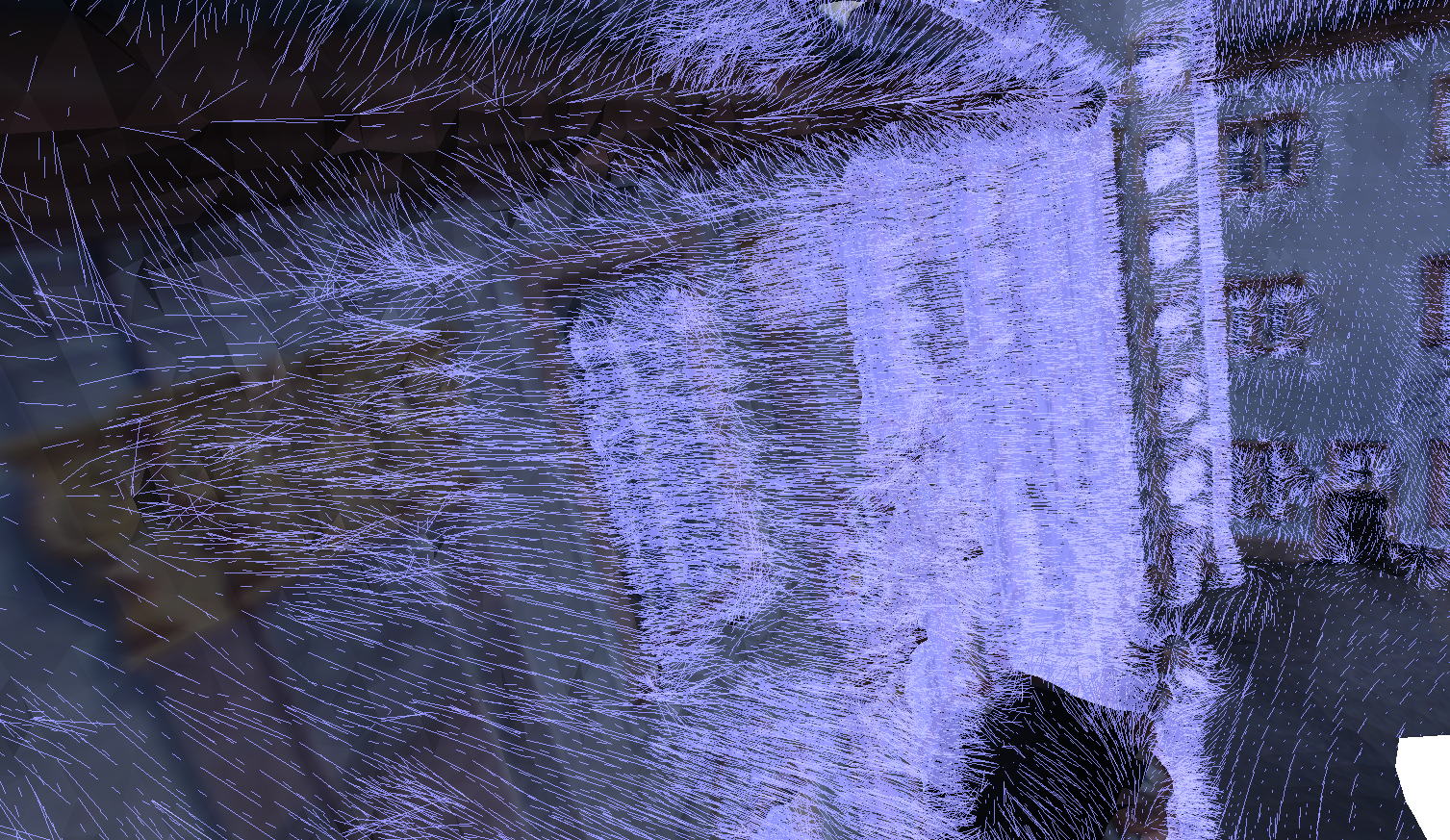
We present a new solver for estimating a surface normal from a single affine correspondence in two calibrated views. The proposed approach provides a new globally optimal solution for this over-determined problem and proves that it reduces to a linear system that can be solved extremely efficiently. This allows for performing significantly faster than other recent methods, solving the same problem and obtaining the same globally optimal solution. We demonstrate on 15k image pairs from standard benchmarks that the proposed approach leads to the same results as other optimal algorithms while being, on average, five times faster than the fastest alternative. Besides its theoretical value, we demonstrate that such an approach has clear benefits, e.g., in image-based visual localization, due to not requiring a dense point cloud to recover the surface normal. We show on the Cambridge Landmarks dataset that leveraging the proposed surface normal estimation further improves localization accuracy. Matlab and C++ implementations are also published in the supplementary material.