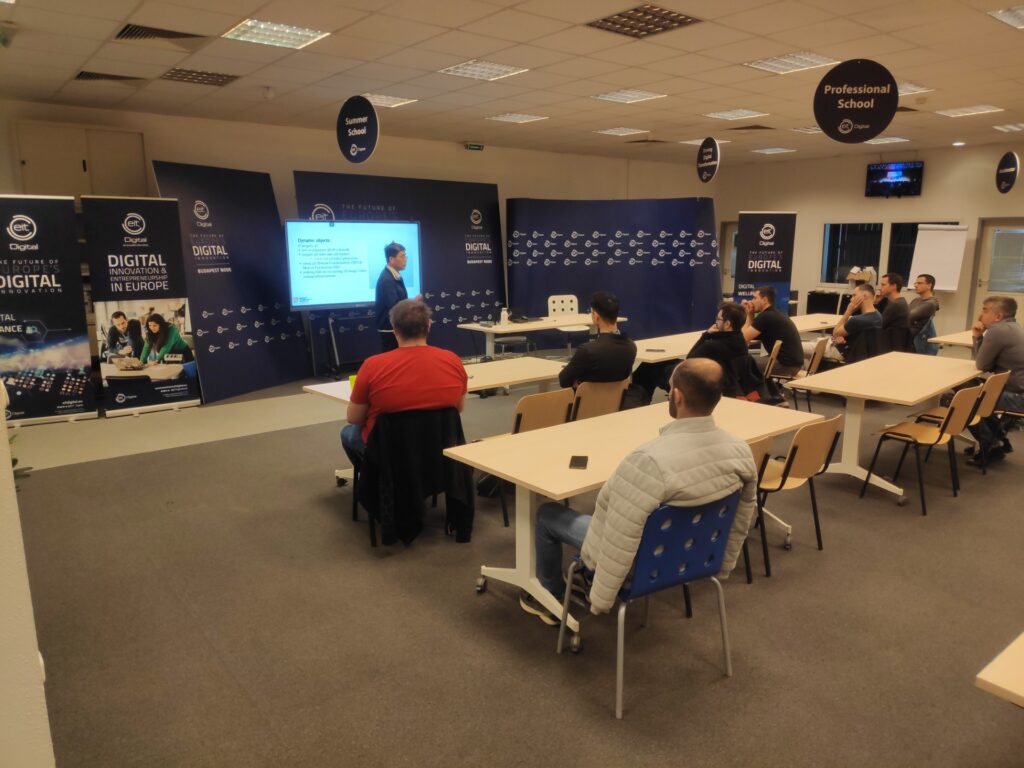
On 13 May, Professor Weisi Lin from Nanyang Technological University, Singapore, visited our research group. He gave a seminar entitled ‘Exploring Opportunities with 3D Point Clouds‘.
Abstract
3D point clouds (PCs) become increasingly available for diversified scenarios, thanks to
economical creation of a digital twin for almost everything, enabled by substantial
advancement of depth sensing, photogrammetry, and deep learning. This offers a
practical bridge between our physical world and its expanding virtual counterpart,
promote integration of computer vision and computer graphics that have been two
separate realms for long, and facilitate mixed reality and multimedia interaction.
Therefore, unprecedented possibilities are expected in digital transformation and smart
cities, toward robot navigation, autonomous driving, gaming/entertainment, social
media, industrial metaverse, BIM, urban surveillance/planning, digital art, cultural
heritage preservation, future training/education, crime investigation, and discovery in
medical/biological/material sciences. PCs can be also used to generate alternative
representation of 3D visual content, like 3D meshes and emerging Gaussian splatting.
This talk will present the recent research and development for representation,
processing and evaluation of PCs, with humans and machines as ultimate users,
respectively. Related important topics include various filtering, simplification,
compression, registration, shape/mesh construction, saliency/quality evaluation, and
image-based localization. Possible future research directions will be highlighted and
discussed as well.